Pharmacology of Carbonic Anhydrase Inhibitors

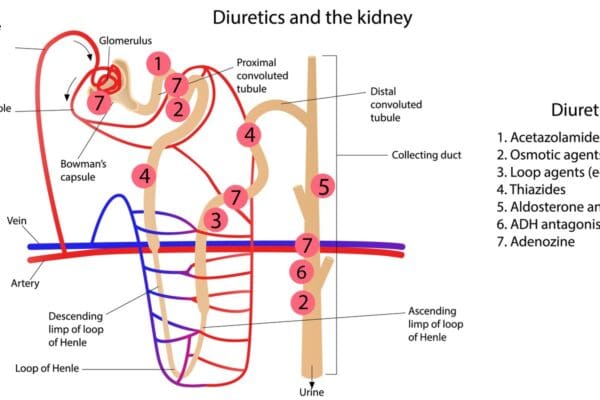
Mechanism of Action: Carbonic Anhydrase Inhibitors (CAIs) act primarily on the proximal convoluted tubule in the kidneys. They inhibit the enzyme carbonic anhydrase, which is essential for the reabsorption of bicarbonate ions. This leads to increased excretion of bicarbonate, sodium, and water, resulting in mild diuresis and acidification of the urine. Pharmacokinetics: Drug Examples: Clinical…
Read More

Pharmacology of Osmotic Diuretics

Mechanism of Action: Osmotic diuretics work by increasing the osmolarity of the filtrate in the renal tubules. They are filtered by the glomerulus but not reabsorbed, leading to an osmotic gradient that draws water into the nephron. This results in increased urine output and decreased intracranial and intraocular pressure. Pharmacokinetics: Drug Examples: Clinical Use: Side…

Read More

Pharmacology of Potassium-Sparing Diuretics

Mechanism of Action: Potassium-sparing diuretics act on the collecting ducts in the kidneys. They inhibit sodium reabsorption while reducing potassium secretion, effectively sparing potassium levels in the body. There are two main types: Pharmacokinetics: Drug Examples: Clinical Use: Side Effects: Drug Interactions: Contraindications: Understanding the pharmacology of potassium-sparing diuretics is essential for healthcare providers to…

Read More

Pharmacology of Thiazide Diuretics

Mechanism of Action: Thiazide diuretics act primarily on the distal convoluted tubule (DCT) in the kidneys. They inhibit the sodium-chloride symporter, leading to a decrease in the reabsorption of sodium and chloride ions. This results in increased excretion of water, sodium, and chloride, thereby reducing blood volume and blood pressure. Pharmacokinetics: Drug Examples: Clinical Use:…

Read More

Pharmacology of Loop Diuretics

Mechanism of Action: Loop diuretics primarily act on the ascending limb of the Loop of Henle in the kidneys. They inhibit the sodium-potassium-chloride (Na-K-Cl) co-transporter, which leads to a decrease in the reabsorption of these ions. This action results in an increase in the osmolarity of the filtrate, causing more water to be drawn into…

Read More

Prolongation of Drug Action: A Complete Overview

Extending the duration of a drug action can offer several advantages, such as enhanced patient compliance, reduced frequency of dosing, and minimized side effects. However, it’s crucial to understand that not all drugs are suitable for prolongation strategies. Here are some of the more detailed methods commonly employed to extend the action of a drug….

Read More

Kinetics of Elimination: A Complete Overview of Mechanisms and Implications

Understanding the kinetics of how a drug is removed from the body is foundational for creating and adjusting rational dosage plans tailored to individual patient needs. Three key pharmacokinetic parameters must be comprehended: bioavailability (F), volume of distribution (Vd), and clearance (CL). The first two have been previously discussed. Drug Elimination Drug elimination comprises both…

Read More